

A home lab can become noisier as it becomes better monitored. One unavailable dependency produces a dozen red checks; a brief interruption generates both a failure and a recovery message; an unchanged warning arrives often enough that you stop reading it.
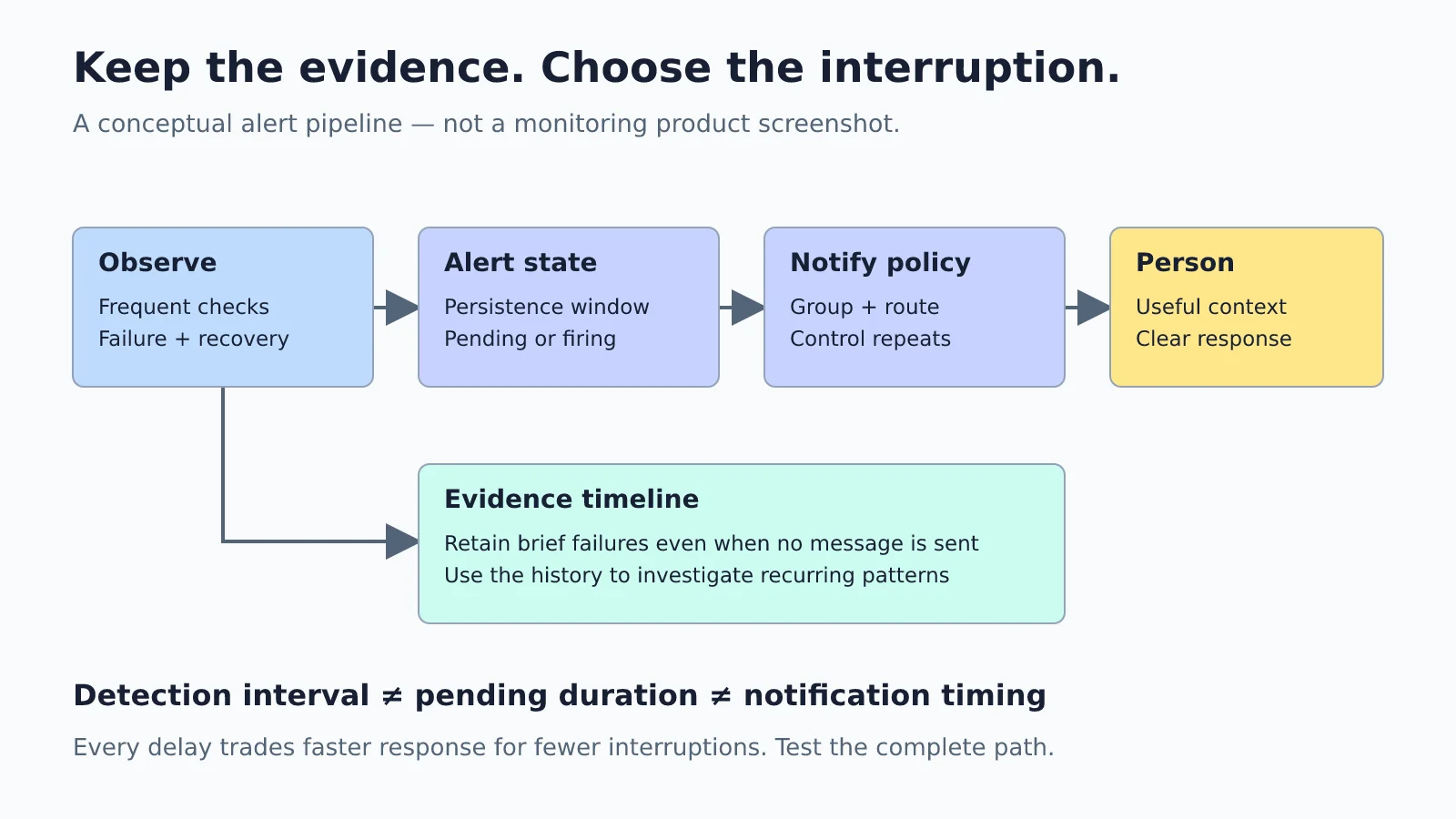
The solution is not to make every check less sensitive. Keep the evidence, but be selective about interruptions. Detection, alert state and notification delivery are separate jobs. Treating them separately makes monitoring more useful without pretending that short failures never happened.
Start with an interruption budget
Before adjusting timers, decide what deserves your attention now. A public service that nobody can reach may justify an immediate investigation. A backup that missed its expected completion needs attention before the recovery window becomes unacceptable. A development container that you intentionally stopped probably belongs in a dashboard, not on your phone.
These are policy choices, not universal severity levels. Write one sentence for each notification: what is affected, why it matters and what you can do. If you cannot identify a useful response, consider a daily summary instead. Do not quietly remove checks that protect data just because they are inconvenient; fix the signal or its routing.
Detection is not delivery
Prometheus makes the distinction explicit. Its alerting rules evaluate expressions; an optional for duration keeps an active condition pending until it has remained active across the required evaluations. Alertmanager handles the next stage: routing and notifications. The official alerting-rule documentation describes these states.
That is different from slowing the underlying check. A frequent check can preserve a useful timeline while a persistence requirement avoids waking you for every isolated failure. The tradeoff is delayed notification of a genuine outage. A short tolerated interruption for a personal dashboard may be unacceptable for another workload.
Missing data also deserves its own policy. A failed probe and a probe that never ran are not interchangeable. Do not assume that adding a persistence timer automatically detects a dead monitoring process or a vanished metric series.
There is more than one notification clock
Alertmanager provides three particularly useful controls. They apply to notification groups, not to the frequency at which your service is measured:
group_wait: the initial wait for a new group, allowing related alerts to arrive before its first notification. If an alert resolves before that wait elapses, Alertmanager does not notify for that alert.group_interval: the cadence for checking whether an existing group has changed and needs another notification.repeat_interval: how long to wait before repeating an unchanged notification, subject to the grouping cadence and retention behavior.
The official Alertmanager configuration reference explains the details. The important practical lesson is that “wait before firing” and “wait before notifying a group” are not the same setting. Check the vocabulary of your own monitoring tool rather than transferring configuration names blindly.
Nor is delivery time simply one configured number. Check intervals, evaluation timing, pending duration, grouping and the notification transport can all contribute. Define a tolerable end-to-end delay, then measure it.
Group by the response, not by convenience
A useful group brings together failures that a person would investigate together. For a small deployment, service and environment labels can be a reasonable starting point. Grouping everything under “home lab” produces a vague alarm. Grouping every individual instance separately can produce a message storm.
Keep member identities in the notification body even when the title summarizes the group. “Photo service: database and web checks failing” is more actionable than “Applications down.” A parent or group turning red is evidence of an affected member, not proof that every member failed.
Inhibition is another tool: a matching source alert can mute notifications for matching target alerts. For example, a dependency failure could suppress its downstream symptoms. Scope it carefully with labels shared by the correct source and targets. An overly broad rule can hide a second, independent outage. Inhibition suppresses noise; it does not establish root cause or repair anything.
Recovery should close the loop
A recovery notification should say what monitoring has actually observed. “Checks are passing again” is defensible. “The network fixed itself” is a diagnosis you may not have evidence for.
Flapping can make the recovery side noisy too. Prometheus offers keep_firing_for to continue a firing alert for a duration after its condition was last met. It can reduce premature resolutions, but it also delays the visible return to normal. Check support in your deployed version and choose it deliberately; it is not a substitute for investigating repeated interruptions.
A small experiment without a real outage
Use a disposable test rule or a test monitor routed to a private test receiver, not a production service shutdown. The following is an experiment plan, not a configuration tested on your installation:
- Create one clearly labeled test signal with a known owner and cleanup time. Confirm that it cannot trigger remediation or notify other people.
- Generate a brief failure shorter than your chosen persistence window. Confirm that the evidence remains visible even if no interruption is sent.
- Generate a longer failure. Record when the condition began, when it fired and when the receiver actually got the message.
- Add a related test alert. Check that grouping preserves both identities and does not unexpectedly suppress unrelated alerts.
- Restore the test signal, verify recovery behavior, then remove the temporary rule and receiver configuration.
Keep tokens, webhook URLs and message contents out of public screenshots. Delivery credentials belong in your tool’s protected secret mechanism, not in an article or a reusable example.
The goal is a trustworthy interruption, not a silent dashboard. Preserve observations, make delays intentional and test the entire delivery path. A smaller number of messages becomes valuable only when you can still explain what happened and know that the next important failure will reach you.